

Eugene Gendlin was an Austrian-born American psychotherapist who developed Focusing - a therapeutic method that encourages people to tune into their bodies to gain deep insight into their emotional and psychological challenges.
Eugene Gendlin:
the Felt Sense
Focusing is based on three principles
“First, that there is a kind of bodily awareness that profoundly influences our lives and that can help us reach personal goals.” Gendlin coined the term “felt sense” to describe it.
“And second, that a felt sense will shift if you approach it in the right way. It will change even as you are making contact with it. When your felt sense of a situation changes, you change—and, therefore, so does your life.”

A felt sense
“A felt sense is not a mental experience but a physical one. Physical. A bodily awareness of a situation or person or event. An internal aura that encompasses everything you feel and know about the given subject at a given time-encompasses it and communicates it to you all at once rather than detail by detail. Think of it as a taste, if you like, or a great musical chord that makes you feel a powerful impact, a big round unclear feeling.”
“A felt sense doesn't come to you in the form of thoughts or words or other separate units, but as a single (though often puzzling and very complex) bodily feeling.”
“Since a felt sense doesn't communicate itself in words, it isn't easy to describe in words. It is an unfamiliar, deep-down level of awareness that psychotherapists (along with almost everybody else) have usually not found.” Focusing, page 32, 33
The inner act of focusing can be broken down into six main parts. As you become more proficient at listening to your body, you will begin to see these parts as a single process. Thinking of them as separate movements makes the process seem mechanical rather than fluid.
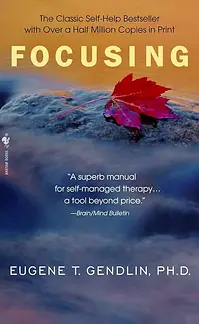

The focusing manual
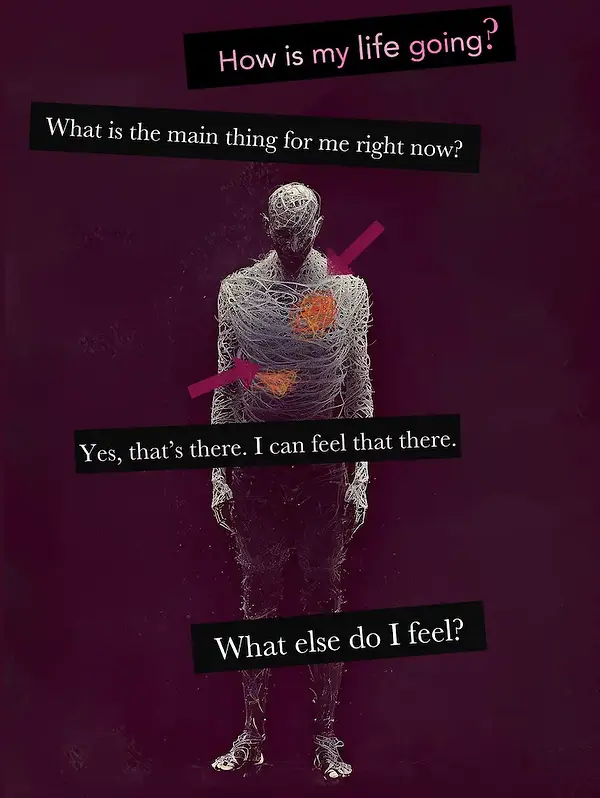
1 Clearing a space
Take a moment to relax and be silent. … Now, pay attention inwardly, to your body, perhaps to your stomach or chest. See what comes there when you ask:
"How is my life going?
What is the main thing for me right now?"
Sense within your body. Let the answers come slowly from this sensing. When something comes up don’t try to analyze it. Step back and say:
"Yes, that's there. I can feel that, there."
Let there be a little space between you and that. Then ask:
“What else do I feel?” Wait again, and sense. Usually several things will come up.

2 Felt sense
From the issues that arose, select one to focus on. Do not try to analyze it. Stand back from it. The problem will be complex with many parts to it.
Pay attention there where you usually feel things, and in there you can get a sense of what all of the problem feels like. Let yourself feel the unclear sense of all of that.
3 Handle
What is the quality of this unclear felt sense? Let a word, a phrase, or an image come up from the felt sense itself. It might be a word like tight, sticky or scary. It could be a phrase or an image. Stay with the quality of the felt sense till something fits it just right.

4 Resonating
Go back and forth between the felt sense and the word phrase, or image. Check how they resonate with each other. See if there is a bodily signal that lets you know there is a fit.
Let the felt sense change. Let the word, phrase, or picture change too, until it feels just right in capturing the quality of the felt sense.

5 Asking
Now ask:
“What is it, about this whole problem, that makes this quality which I have just named or pictured?
Make sure the quality is sensed again, freshly, vividly (not just remembered from before). When it is here again, tap it, touch it, be with it, asking,
"What makes the whole problem so?"
Or you ask,
"What is in this sense?"
If you get a quick answer without a shift in the felt sense, just let that kind of answer go by. Return your attention to your body and freshly find the felt sense again. Then ask it again.
Be with the felt sense till something comes along with a shift, a slight "give" or release.


6 Receiving
Receive whatever comes with a shift in a friendly way. Stay with it a while, even if it is only a slight release. Whatever comes, this is only one shift; there will be others. You will probably continue after a little while, but stay here for a few moments.

IF DURING THESE INSTRUCTIONS SOMEWHERE YOU HAVE SPENT A LITTLE WHILE SENSING AND TOUCHING AN UNCLEAR HOLISTIC BODY SENSE OF THIS PROBLEM, THEN YOU HAVE FOCUSED. It doesn't matter whether the body-shift came or not. It comes on its own. We don't control that.


