
Rosacea: Looking Beyond the Redness
- Rodger Douglas
- May 6, 2018
- 4 min read
Updated: 17 hours ago

Rosacea is a common inflammatory skin condition that primarily affects the face, especially the cheeks, nose, forehead and chin. It often begins with a tendency to flush or blush easily. Over time, the redness may last longer and become more persistent. For some people there may be burning, sensitive skin, visible blood vessels, spots or pustules. The eyes can also be affected.
Rosacea was once called acne rosacea, but the name is misleading. Although some forms of rosacea can produce acne-like spots, rosacea and acne are different conditions. Blackheads and whiteheads, for example, are characteristic of acne rather than rosacea.
What Does Rosacea Look Like?
Rosacea can appear very differently from one person to another. Common signs include:
flushing or blushing easily
persistent redness or colour changes across the face
small visible blood vessels
burning, stinging or unusually sensitive skin
red bumps and pustules
dry, rough, itchy or flaky skin
swelling
thickening or bumpiness of the skin
enlargement and thickening of the nose in more advanced cases
watery, dry, irritated or bloodshot eyes
sensitivity to light or recurrent irritation around the eyelids
Not everyone experiences all of these symptoms. One person may primarily have flushing and visible blood vessels, while another develops sensitive skin and inflammatory spots.
This is one reason I prefer to look at the individual rather than simply at the name of the condition.
Why Does Rosacea Develop?
There is still no single established cause of rosacea. Research suggests that several things may be involved, including inflammation, an unusually reactive vascular system, immune responses, the skin barrier, nervous-system signaling and microorganisms naturally living on the skin.
What we can often identify, however, are the things that aggravate a particular person's skin.
This is where a little detective work can be useful.
Finding Your Own Triggers
People with rosacea often discover that certain situations make their skin noticeably worse.
Common triggers include:
sunlight
hot weather
cold or windy weather
hot baths or showers
vigorous exercise
alcohol
hot drinks
spicy foods
emotional stress
sweating
irritating cosmetics or skin-care products
certain medications
But a trigger for one person may have absolutely no effect on another. Rather than following a long list of foods and activities that someone with rosacea is supposedly forbidden to enjoy, it can be much more useful to observe your own skin. Keeping a simple diary for several weeks can help. Note when the rosacea becomes worse and what was happening beforehand. Patterns sometimes become surprisingly obvious.
Nutrition
There is no single "rosacea diet" that is suitable for everyone.
One person may notice that wine reliably produces flushing. Another reacts to very spicy food or piping-hot drinks, while someone else can enjoy all of these without difficulty.
This makes individualized observation more useful than automatically eliminating large numbers of foods.
I would also look at the broader picture of nutrition rather than concentrating exclusively on individual triggers: Is the person eating a varied and nourishing diet? Are meals mostly made from fresh, minimally processed foods? Is there anything in the person's normal eating pattern that seems to coincide consistently with their symptoms?
The goal isn't to become frightened of food. It is to understand your own body better.
Stress, Emotions and the Skin
Rosacea provides a particularly interesting example of the relationship between the mind, nervous system and skin. Most of us know what it is like to blush when embarrassed. Emotional changes can produce visible changes in the circulation of the face within seconds. In rosacea-prone skin, this vascular response can be much more pronounced. Emotional stress is a commonly reported trigger, alongside sunlight, heat, wind and exercise.
There can also be a vicious circle:
stress → flushing → embarrassment or self-consciousness → more stress → more flushing
Because rosacea occurs on the face, its emotional effect shouldn't be underestimated. Someone may become anxious about photographs, social situations, meeting new people or simply being looked at.
This doesn't mean that rosacea is "all in the mind." It is a genuine physical skin condition. But for someone whose symptoms clearly respond to stress, looking after the emotional and nervous-system side of health may be just as worthwhile as looking after the skin.
Homeopathy and Cell Salts
When I use homeopathy, I don't choose a remedy simply because somebody has rosacea.
Two people can have similar-looking skin but be very different in almost every other respect.
I therefore look at the complete picture: what the skin feels like, what makes it better or worse, sensitivity to heat or cold, general health, digestion, sleep, energy, emotional state and the person's individual pattern of symptoms.
Homeopathy and cell salts can be considered as complementary parts of an individualized whole-person approach. They shouldn't replace appropriate medical assessment, particularly when symptoms are severe, changing or affecting the eyes.
Gentle Skin Care
Rosacea skin usually doesn't appreciate being scrubbed, stripped or repeatedly treated with strong products.
Often, gentler is better.
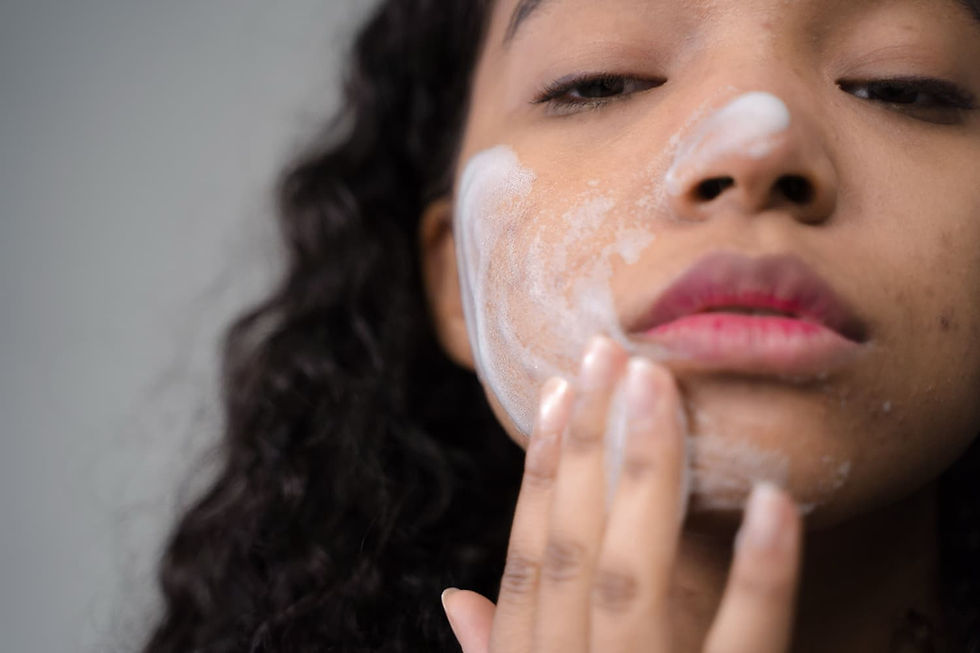
A simple routine may include a mild cleanser, regular moisturising and careful sun protection. Dermatologists recommend broad-spectrum SPF 30 or higher, and mineral sunscreens containing zinc oxide or titanium dioxide can be easier for some sensitive skins to tolerate.
Products containing fragrance, alcohol, menthol, camphor or strong exfoliating acids can irritate some rosacea-prone skin. Toners, astringents and vigorous scrubbing may also make matters worse.
Again, everyone's skin is different. A product described as "natural" can still irritate sensitive skin, while a very simple commercial moisturiser may be perfectly well tolerated.
The skin itself gets the final vote.
Looking at the Whole Person
Rosacea is a good example of why I don't like looking at skin problems in isolation.
Sometimes the most important factor is the skin barrier itself. Sometimes sunlight and temperature dominate. For another person, particular foods or drinks repeatedly provoke flushing. In someone else, emotional stress may be a major trigger.
There doesn't have to be one mysterious hidden cause behind every case.
Instead, I prefer to ask:
Why does this person's skin behave the way it does, and what seems to make it better or worse?
By looking at nutrition, stress and emotional wellbeing, individual remedies, daily skin care and the person's unique triggers, we can begin to see a much fuller picture than the redness alone.


Comments